The story behind the fictional product
We thought managing a website should be easier than managing a toaster.
Then again, nobody has ever asked us to update fourteen plugins before making breakfast. Pagekeeper is a fictional company built around a practical idea: routine website work ought to leave room for the rest of your business.
Our fictional origin story
It started with a small change. Naturally, it got complicated.
The Pagekeeper story starts with a familiar scene: someone needs to change a sentence on a business website. The sentence is ready. Finding the sentence is proving more ambitious. There are several dashboards, a forgotten layout tool and a button whose owner is apparently on holiday.
A modest starting point
What if everyday edits had an obvious home? That question became the premise for Pagekeeper, rather than a plan to put another control panel on top of the old ones.
A business problem first
The person changing the website should be able to concentrate on the business, the words and the visitor. Software earns its place by helping with those jobs.
What we value
Useful beats impressive-looking.
A website is supposed to help run the business, not become another department. These are the principles behind our fictional product.
Make the ordinary obvious
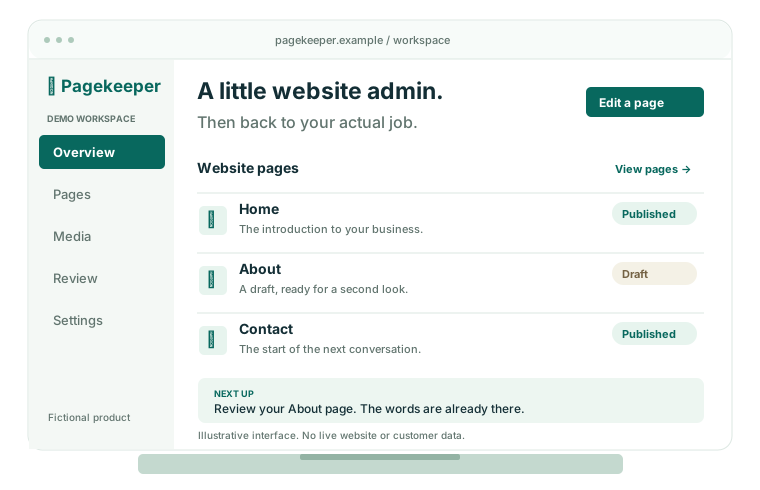
Page names, next steps and publication states should explain themselves. A colleague should not need a guided tour to correct an opening time.
Respect the person doing the work
Clear language and a manageable sequence matter more than a dashboard full of possibilities. Nobody has ever asked for a more immersive settings menu.
Choose tools for a reason
WordPress can be a capable platform, and specialist tools have their place. We question unnecessary complexity, not the people who inherited it.
How we think about the work
Less software theatre. More getting on with it.
We would rather explain a useful workflow than promise that websites never need attention. Good decisions still need a human, and a tidy interface is not a substitute for knowing what matters.
Start with a real task
Find a page, make an edit, check it and publish. Design the journey around the work someone actually came to do.
Leave room for judgement
A review step should help someone notice a mistake. It should not be a ceremony performed because the software enjoys meetings.
Be clear about the example
Pagekeeper is a fictional demonstration of these ideas. It has no named founders, employees, customer results or operational service behind it.
Enough about the idea. See how it fits together.
Explore the fictional pages, publishing flow and everyday website tasks that inspired Pagekeeper.